
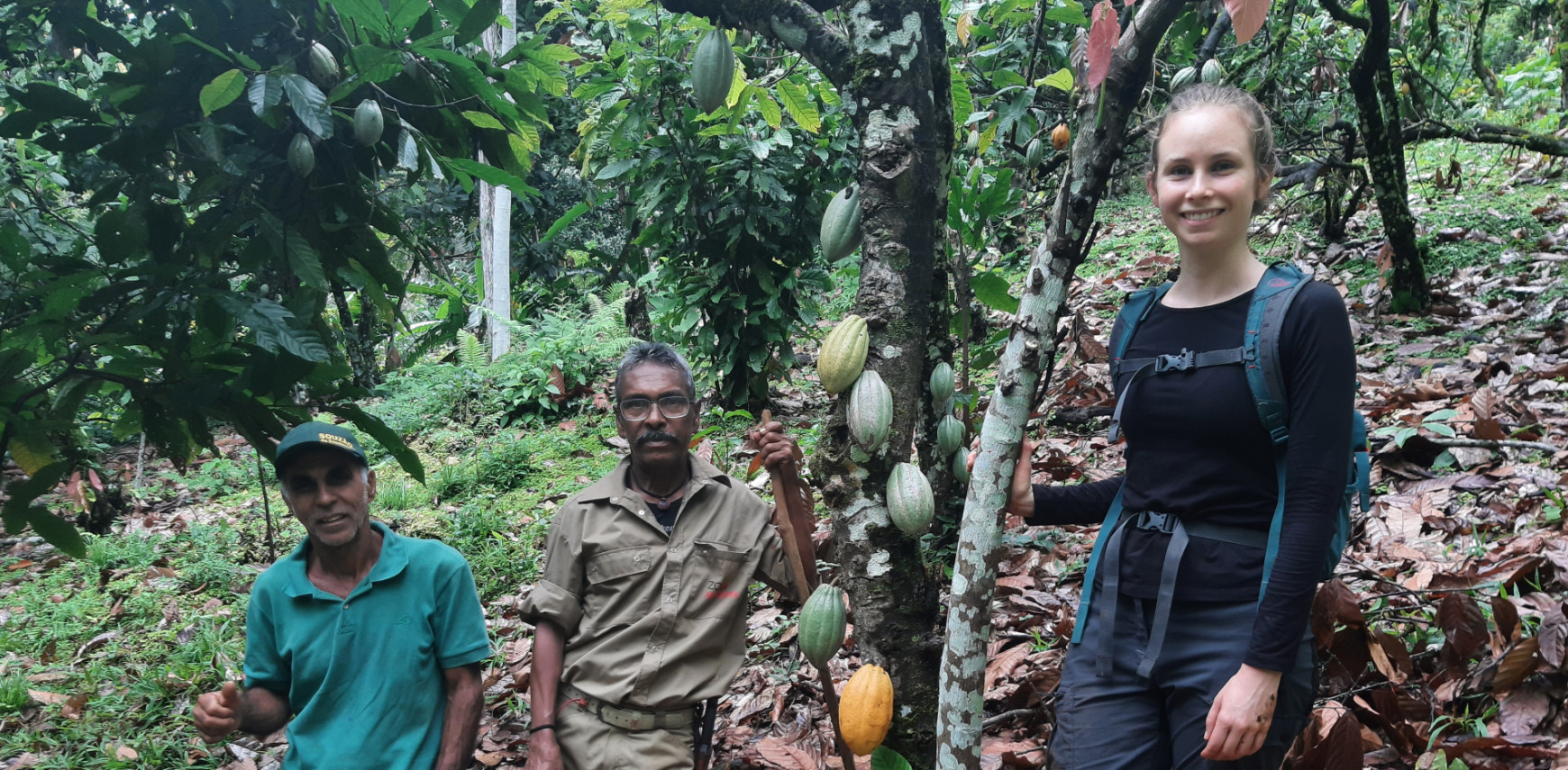
Shade trees, wild animals and farmers: can cocoa cultivation be good for people and nature?
Cocoa, the key ingredient of chocolate, grows in tropical regions where forests are under severe pressure. Tropical agriculture is often associated with deforestation and the loss of biodiversity. At the same time, millions of small-scale farmers depend on it for their livelihoods. Is there a way to grow cocoa more sustainably?
Researcher Steffi Dekegel investigated this in Brazil, within our Project BioBrasil in Bahia. She recently completed her PhD thesis in a joint trajectory between UCLouvain (Belgium) and the State University of Santa Cruz (Brazil). Steffi studied traditional cabrucas: cocoa plantations where cocoa grows under the shade of forest trees. Cocoa cultivation under such a roof of shade trees offers a promising middle ground, but how this system is managed makes a world of difference.
Her findings show that more shade trees in cabrucas benefit biodiversity, including the endangered golden-headed lion tamarin, without compromising farmers' incomes. At least 100 shade trees per hectare are required for the golden-headed lion tamarins to be able to use these traditional agroforestry plantations. While more shade trees can slightly reduce cocoa production, production costs also decrease, so overall profits remain stable.
Yet shade trees alone are not enough. For this system to work for both nature and farmers, farmers also need better access to resources, more gender equality and stronger local support. Without that, sustainable systems remain difficult to achieve. Cocoa cultivation, with the right support, can therefore not only provide chocolate, but also be good for both people and nature.
Project BioBrasil will now continue to work with local partners on the findings and recommendations of this study. The focus is on amending the current legislation on shade trees, so that it aims to preserve at least 100 shade trees in cabrucas. Activities will also be set up to help cocoa farmers to make their cabrucas more economically viable. In addition, we will look for ways to compensate farmers for the conservation of shade trees, for example through biodiversity credits and extra income that comes directly from these trees.
In this way, cocoa cultivation, with the right support, can contribute to both biodiversity and the livelihoods of farmers.