
The Art of Casting a Gorilla
In the space of just one year, three animals in the Antwerp ZOO gorilla group needed casts to treat their injuries. What initially appeared to be a coincidence gave veterinarian Jonas Spruyt and his team valuable practical experience in veterinary medicine, behaviour and group dynamics. This experience ultimately led to a unique solution for treating injuries in gorillas.
A bite wound in a tricky spot
Several months ago, a new male gorilla arrived at Antwerp ZOO: a silverback named Ayo. During one of his first introductions to the female group, five-year-old Vizazi sustained a deep bite wound to the back of her knee.
‘Bite wounds are always delicate, because bacteria from an animal’s mouth can easily cause infections,’ says veterinarian Jonas Spruyt. ‘In Vizazi’s case, this was even more challenging, as the wound was located at the back of her knee, an area that is under constant tension with every movement.’
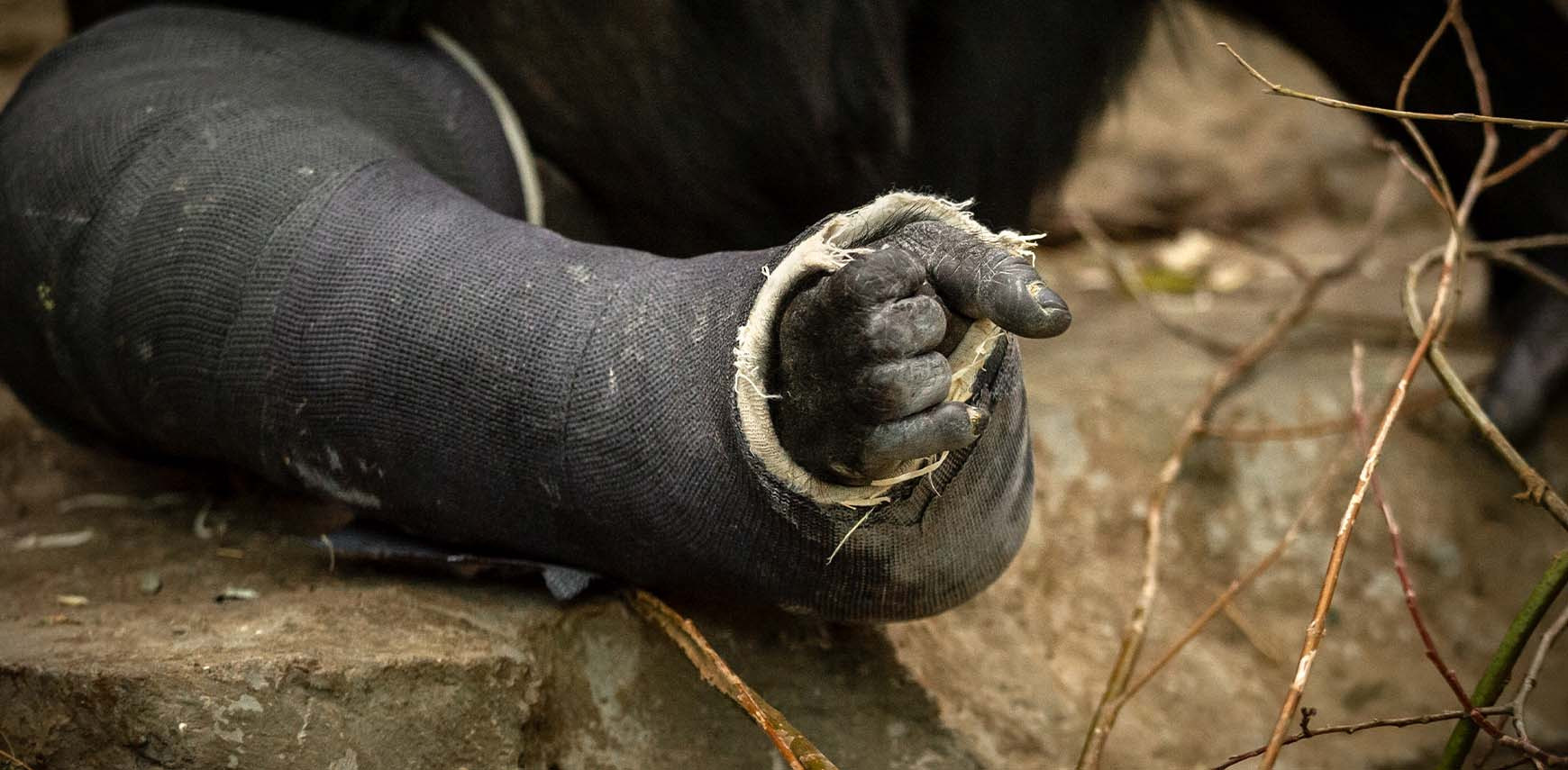
The young gorilla toddler was therefore anaesthetised so that the wound could be thoroughly cleaned and the damaged muscle repaired. ‘We applied a special cast extending from her heel to her groin. This immobilised the knee and protected the wound. An added benefit was that, with her entire leg encased in plaster, she was unable to tamper with the stitches.’
A patient That won’t sit still
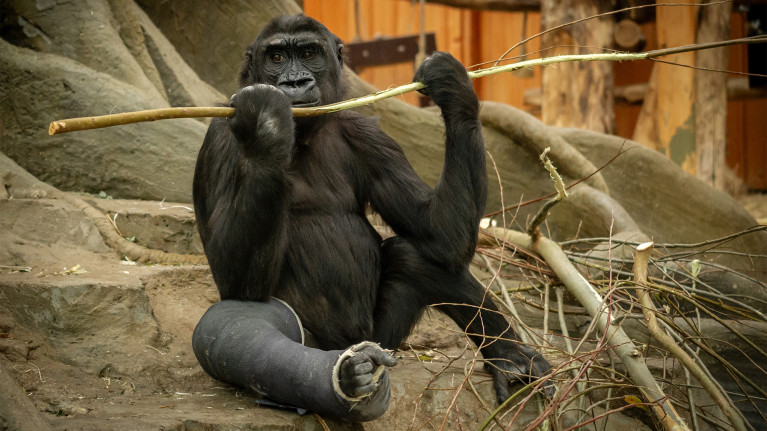
Casting a leg may at first seem like a routine procedure. However, when the patient is a gorilla, it’s a bit trickier. These primates are strong, intelligent and exceptionally curious. To them, a cast is not a medical aid, but a strange object that needs to be thoroughly explored and tested. It wasn’t long before Vizazi destroyed the first cast. The team therefore had to come up with a stronger solution.
‘You can’t ask a gorilla to sit still for a few weeks and keep her leg up,’ adds Spruyt. Animals living in a social group move about, climb, and play. That makes protecting an injury all the more challenging. ‘When Vizazi bit through her first cast, we had to come up with an alternative. We ended up visiting a DIY shop to buy some aluminium mesh. We incorporated this into the cast and secured it with small screws. This made the cast strong enough without making it too heavy.’
The gorilla-proof cast turned out to be exactly what was needed. The cast remained in place long enough for Vizazi’s injury to heal. An aluminium mesh-reinforced cast extending all the way from the heel to the groin has never been used on a gorilla before.
This case therefore attracted considerable interest from other veterinarians. During a veterinary conference at Antwerp ZOO, veterinarian Jonas Spruyt presented the case to around ninety colleagues from Belgium and abroad. This unique and unexpected solution, developed here in Antwerp, is now contributing to veterinary knowledge on great apes worldwide.
A New Silverback
Vizazi was injured during a tense moment – the introduction of a new male gorilla to the group. The group had been without an adult male since the silverback Matadi died in 2023. In the wild, gorillas live in a harem structure, where a single silverback is the central figure for a group of females and their young. The presence of a silverback is therefore essential for a stable group. He serves as the group’s leader and protector, maintaining order and ensuring the safety and well-being of the entire group.
Ayo was transferred to Antwerp from a French zoo specifically for this purpose. The gorilla, almost thirteen years old and weighing around 200 kilograms, was selected for his strong genetic compatibility with the females to be the new breeding male in the European species conservation programme.
International cooperation among European zoos is crucial, as the western lowland gorilla is highly endangered. It is estimated that around 90,000 of these animals still live in the wild, mainly in the lowland swamps of Central Africa, particularly in the Congo and Cameroon. Their habitat is under pressure from deforestation and illegal hunting for bushmeat. They also face significant health threats from diseases such as Ebola. On top of that, gorillas have a slow reproductive rate: females reach maturity at eight to ten years old and typically give birth to a single infant every four to five years. By maintaining a healthy zoo population, organisations are working together to support species conservation. Zoo gorillas also serve as ambassadors for their wild counterpart.
Getting to know each other
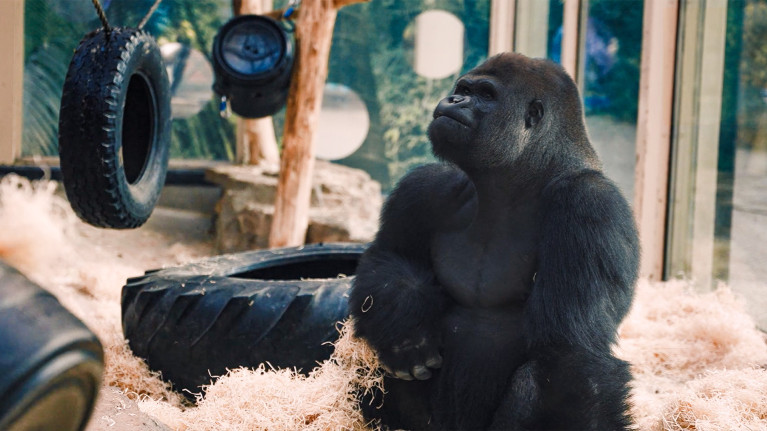
Introducing a new male gorilla to an existing group is a process that requires careful planning, progressing one step at a time at the animals’ pace. ‘When Ayo arrived at the zoo, he was kept in a separate enclosure for his first day, where he could see the females and they could see him,’ recalls Sarah Lafaut, Curator of Mammals. ‘In the next phase, they become familiar with each other’s scent and are allowed to make gentle contact through a partition. Only once these steps proceed calmly do we effectively allow the gorillas to stay in the same enclosure.’
Still, introductions like this rarely go smoothly. ‘Gorillas often communicate through displays of dominance,’ adds Lafaut. ‘A silverback can make himself appear larger and more intimidating: his hair stands on end, he pounds his chest, throws objects, or shakes the climbing frames. This behaviour is his way of showing that he is in charge.’
Ayo’s introduction to the adult females went very well. However, the two young gorillas, Vizazi (5) and Thandie (7), grew up without a silverback and had never experienced a male leader in their group. As a result, they weren’t aware of the social rules. ‘They sometimes challenged Ayo or got involved in tense situations within the group, to which he responded, asserting his leadership. Unfortunately, this didn’t go well for some of our youngsters.’
A complex fracture
Vizazi was not the first gorilla at Antwerp ZOO to have a cast put on her leg. Thandie had sustained a similar injury several months earlier, which also required a cast. She had suffered a complex fracture in her lower leg while playing.
‘We put Thandie under anaesthesia to thoroughly examine her leg,’ explains Spruyt. ‘We took X-rays to gain a clearer picture of the injury. Because this was a complex fracture in the lower leg, we called in a specialist orthopaedic surgeon. He inserted tiny plates into the broken bone and used two pins to stabilise a bone fragment.’
To increase the chances of a successful recovery, the veterinarian applied a cast, which Thandie would have to wear for eight weeks. ‘Applying a plaster cast is one thing,’ Spruyt continues. ‘Making sure it stays put is something entirely different. A curious primate like Thandie can’t resist investigating an interesting object like a plaster cast. She regularly tried to gnaw at it or pry it loose.’
So, the team had to get creative. One idea was to sprinkle the cast with cayenne pepper during the application process to make the taste unpleasant for Thandie. But it didn’t have the desired effect. Thandie didn’t mind the taste at all. Her caretakers also painted her nails to distract her whenever her attention was drawn to the cast – a trick that worked some of the time, but not always.
Giving her medication also required some creativity from the staff. ‘Thandie quickly noticed whenever we put medication in her food,’ says Lafaut. ‘We tried to mask the bitter taste with something sweet, such as fruit or jam. Because our gorillas don’t get these treats very often, the trick usually works. Thandie, however, refused to be fooled – until we tried chocolate. She had never tasted it before, so even with the medication hidden inside, she was delighted to eat it.’
Once again
Later in the introduction process, Thandie also sustained a bite injury during an encounter with Ayo. This time, the team could draw on their prior experience. A cast was again needed to protect the wound.
Ayo’s introduction to the group is still ongoing. ‘A process like this can take months and rarely goes smoothly,’ concludes Lafaut. ‘Displays of dominance, challenges and minor scuffles are all part of how gorillas establish their social structure.’ One thing is certain: the veterinary team of Antwerp ZOO has mastered the art of casting gorillas!