
Smart Alliances: Why Animals Cooperate (Even When They Don’t Get Along)
What crested macaques can teach us about cooperation
In the animal kingdom, cooperation appears to come naturally. Lionesses hunt together, meerkats warn each other of danger, chimpanzees share food, and fish work together to catch their prey. Even in human society cooperation is deeply rooted: from hunter-gatherers who relied on one another for survival to today’s complex social structures.
For a long time, scientists believed that cooperation among humans and animals was the product of tolerance and social behaviour: the better they got along, the more likely they were to cooperate. However, that’s not entirely true. What about species with strict hierarchies based on competition and dominance? Even among these, researchers have observed cooperation. A new study by Utrecht University, to which ZOO Planckendael contributed, shows why: cooperation is less about ‘friendliness’ and more about forming smart, selective alliances.
Why bother helping others?
Why would an individual make an effort to benefit another? For a long time, scientists believed the answer lay in kinship and social tolerance. ‘Species that are less aggressive and more socially tolerant usually find it easier to cooperate,’ explains Jonas Verspeek, ZOOresearcher at Planckendael ZOO. ‘Consider the female hornbill, who literally immures herself in a tree crevice during breeding season, sealing the entrance almost completely and becoming entirely dependent on her mate for nourishment. Or the way elephants instinctively form a circle to protect their young when they sense danger.’
However, this doesn’t explain everything. Cooperation has been observed even among less tolerant species with strict hierarchies, such as hyenas or baboons. Competition and dominance are key characteristics of these animal groups. This led researchers to new insights: cooperation is not the product of tolerance alone, but also of dependency between individuals. When and why do some individuals cooperate, and - more importantly - with whom?
To learn more about this, an international team studied six species of macaques, from highly tolerant crested macaques to extremely dominant Japanese macaques. ‘Macaques are ideal for this type of research because you can observe the full spectrum of social systems within a single species,’ continues Verspeek. ‘This allows you to truly understand how cooperation is shaped by social structure.’ The study was conducted in thirteen groups of animals spread across various research institutes and zoos in different countries including Germany, the Netherlands, Finland, Austria, and Belgium.
When cooperation comes down to peanuts
To understand when animals cooperate and with whom, researchers studied the behaviour of crested macaques at Planckendael ZOO using a simple yet revealing test known as the ‘peanut plot’.
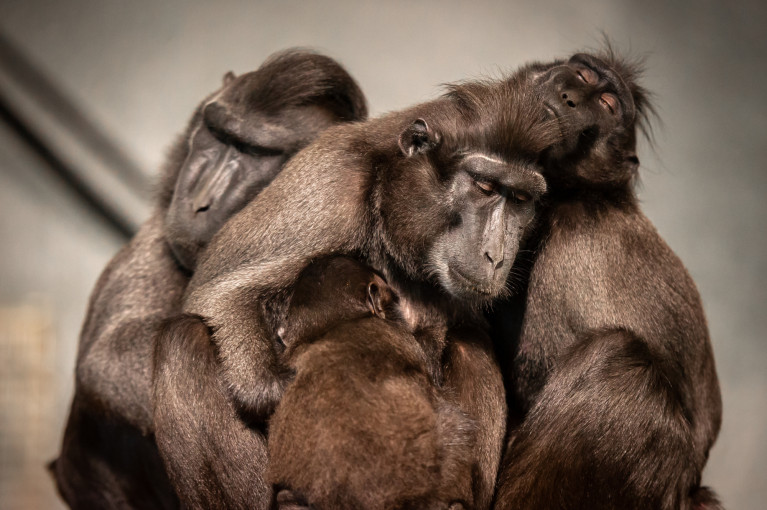
In more tolerant species, such as our crested macaques, several animals can enter the area at the same time and share the peanuts.
A square area (the plot) is marked out on the ground and food is placed inside – peanuts, in this case. ‘This area shows who has access to the food and therefore which animals tolerate one another and which ones are excluded,’ explains Verspeek. ‘In more tolerant species, such as our crested macaques, several animals can enter the area at the same time and share the peanuts.’ This works differently in groups with a stricter hierarchy: there, a dominant individual often determines who is allowed to come closer to the food and who may not.
By combining these observations with knowledge of the group’s social relationships - who is dominant, which animals associate with one another, and which individuals depend on each other - researchers found that cooperation is anything but random. The researchers therefore looked not only at whether animals cooperated, but also at the social structures underlying that cooperation.
Verspeek continues: ‘Cooperation can be expected between animals or individuals that depend on one another in some way. We call this the “interdependence hypothesis”. Cooperation can be observed even among less tolerant species, but in those cases it occurs mainly between specific partners. Animals do not cooperate with everyone, but with a select group of individuals they have a relationship with or depend on.’
These partners can be family members or friends, but also animals that depend on one another in other situations, such as conflicts or group defence. The behaviour itself is not unexpected, but this was the first study to examine it on a larger scale. ‘The way cooperation takes shape depends strongly on the social structure. In groups with a strict hierarchy, it is less evenly spread across the group and more concentrated among specific individuals.’
Does that sound familiar?
Gaining insight into cooperation not only tells us something about how animals behave, but also about group dynamics. By looking at who cooperates with whom, researchers gain a better understanding of relationships within the group. ‘This is valuable information for behavioural scientists,’ says Verspeek. ‘Cooperation reveals which animals have close social ties and which animals rely on one another, and it tells us more about the stability of a group. This helps us make better-informed decisions about aspects such as group composition and animal welfare.’
Although this study focuses on macaques, the same patterns can be observed in other animal species and even in humans. ‘Humans are often considered an exemplary species when it comes to cooperation. However, in humans this also depends on the structure of our relationships and interdependence: we do not cooperate with just anyone - we tend to choose people we know, trust or depend on.’
Research goes beyond a single species
The study on cooperation among macaques is part of a broader research effort. Several research projects are currently underway at the Antwerp ZOO and Planckendael ZOO research centre, with a clear focus on nature conservation and animal welfare. ‘The combination of scientific expertise and the opportunities zoos provide allows us to study animal behaviour and interactions up close,’ concludes Verspeek.
And that knowledge is not used exclusively at the Antwerp and Planckendael zoos. The science centre works closely with a diversity of international partners and provides data for studies in fields such as conservation genetics, animal behaviour, animal welfare, evolutionary biology and veterinary medicine. Through initiatives such as a biobank, in which biological material is stored for future research, researchers contribute to a broader scientific knowledge base.
All these projects address three major themes: applied animal welfare, applied nature conservation and fundamental zoological research. Together, they form the foundation for a better understanding of animals and for concrete conservation efforts, both in zoos and in the wild. The study on cooperation is just one example, but it forms part of a broader body of research that helps us better understand and protect complex social systems and, ultimately, the species themselves.